
A Guide to High-Torque CNC Exhaust Bending for Stainless Steel Automotive Exhaust Fabrication
Zhangjiagang, Jiangsu, China – November 19, 2026
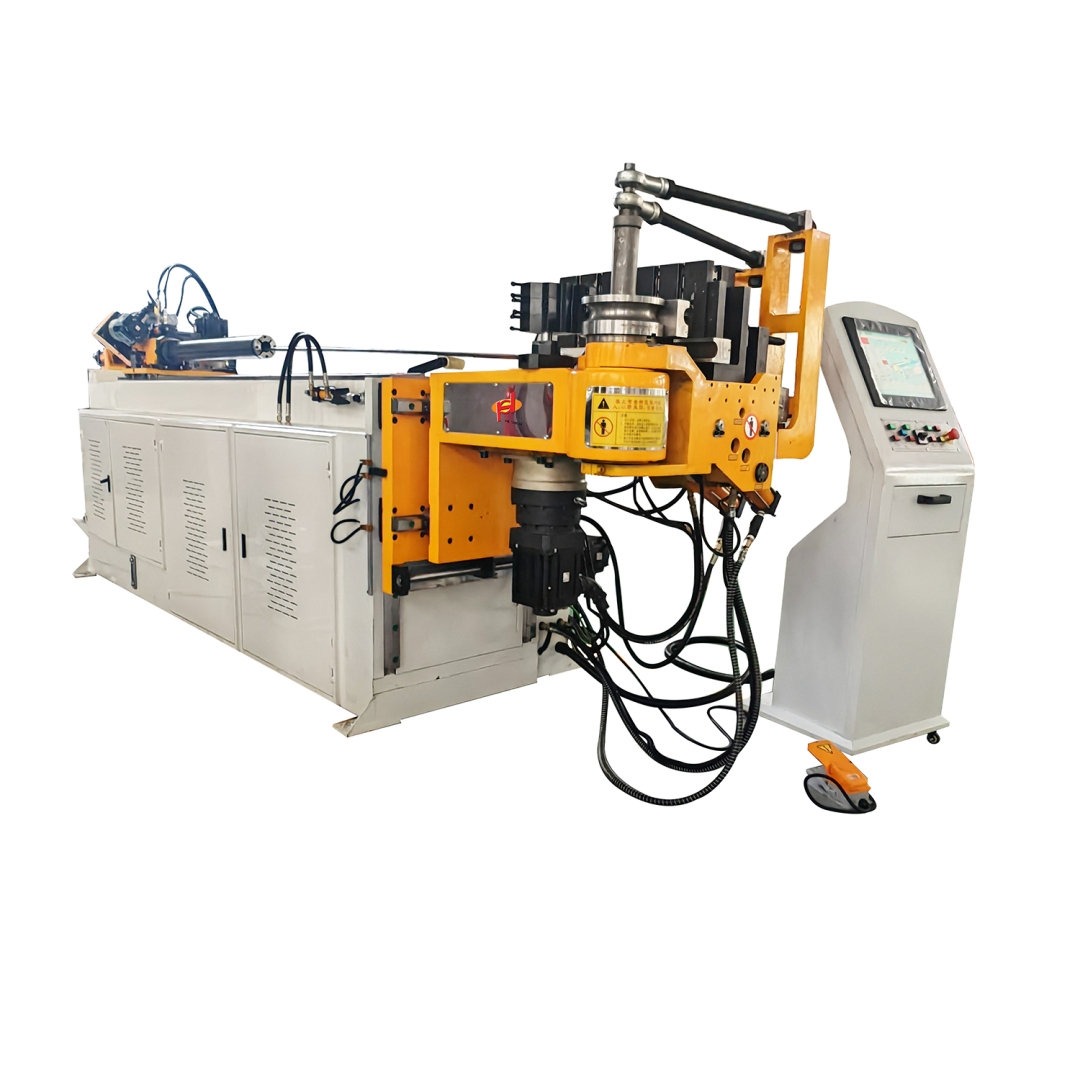
Selecting a cnc exhaust bender requires more than enough force to reach the desired angle. Stainless steel exhaust tubing also needs controlled gripping and section support, particularly where bends are compact or closely spaced. Torque is one part of that forming system. The equipment decision should connect the material and geometry to the tooling arrangement, then establish the finished result through a representative bending trial.
Specify the exhaust component as an assembly part
The tube drawing should identify the material grade, outside diameter and wall thickness. Include the bend radii and the required orientation of its connection ends. Those ends may need to align with a flange, joint or another tube within the exhaust assembly. Use the installed geometry to identify which dimensions control fit. An overall envelope check can help, but it may not reveal a local section change at a bend. If the component has a minimum remaining wall or a defined section requirement, include that characteristic in the inspection method.
Keep appearance requirements explicit. A concealed pipe and a visible tail section may permit different surface marks. The tooling arrangement needs to satisfy the particular component rather than an assumed standard for all exhaust tubing. This can affect the available grip and the choice of contact surfaces.
Evaluate torque together with grip and support
The bending drive supplies the motion and torque needed to form the tube around the die. The clamp transfers that action to the workpiece. If it slips, additional drive capability will not recover the intended relationship between the program and the tube.
An appropriate setup balances the gripping arrangement with the forming task. Tube material, wall thickness and radius influence the required tooling. A difficult bend can also need an internal mandrel and a wiper die to control the section as the tube moves through the forming zone.
Avoid treating force as the default adjustment for every defect. Excess pressure can increase drag or marking and make an unstable setup harder to repeat. Review contact and tool condition when wrinkles or inconsistent movement appear, then adjust the relevant cause.
Retain the section through tight routing
Rotary draw bending pulls the tube around a defined radius. Material on the outside of the bend stretches, while material on the inside experiences compression. The tools need to manage these different conditions if the part is to retain its specified shape.
Mandrel support is particularly relevant to thin walls and restricted radii. Its position and fit belong to the setup, so simply including a mandrel in a quotation does not define the process. The trial needs to establish how the selected tools work with the actual exhaust stock. Heshun offers automatic bending configurations for exhaust applications, including multi-die and left-right arrangements. Their value depends on the part route. A multi-die arrangement addresses different tooling requirements, while a bidirectional arrangement can address access around an already bent section.
Review the order of bends and end operations
An exhaust tube can accumulate a large spatial envelope as it is formed. A later rotation may bring an earlier bend close to the machine frame or tooling. Review the complete sequence and the discharge path before finalizing the equipment arrangement.
Short distances between bends can leave insufficient straight material for a conventional clamp. Application-specific clamping may be needed where an earlier bend occupies the gripping region. This creates a tooling decision that cannot be resolved from outside diameter alone.
The relationship to end forming also needs attention. An expanded or reduced end can affect how a blank is located, while a completed bend can limit access for a later end operation. Select the route that allows both processes to meet their own dimensions without interfering with the next step.
Establish compensation on production material
Stainless steel tubing relaxes after bending, so the released angle can differ from the commanded value. The actual response depends on the stock and setup. Establish the correction through measured samples rather than assigning one universal springback percentage. Record the successful settings alongside the material and tooling identification. Where a new lot produces a different result, that record gives the production team a basis for investigating the change. It also helps prevent a correction for one condition from becoming an unexplained permanent setting.
A cnc exhaust bender should be assessed on the final component after unloading. Axis positioning describes machine movement; dimensional inspection describes the result in the tube. Keeping both records makes the relationship between programmed motion and accepted geometry easier to understand.
Compare capacity using accepted components
Production rate depends on the entire cycle. Blank presentation and removal can be significant when the finished tube has an awkward shape. Include those activities when observing output, and define whether inspection time is inside the measured production boundary.
For an exhaust manufacturer handling several designs, assess tooling changes separately from automatic running. The time to restore an acceptable part affects the available capacity for short batches. A faster bend movement may not improve the daily schedule if setup recovery remains slow.
Use the same tube and inspection criteria when comparing a cnc exhaust bender with another proposed configuration. Record the conditions of the test and any operator intervention. This gives the buying team a useful result rather than an isolated cycle figure with no connection to its production needs.
Evaluate the flow section without assuming a performance gain
The internal passage depends on the tube section retained through each bend. A local change in shape is therefore relevant when the component drawing specifies an internal envelope or section limit. State that acceptance requirement directly rather than relying on descriptions such as a smooth-looking bend.
For a conditional inspection example, examine a representative section at the location where the bend is most demanding. Compare the measured geometry with the drawing and retain its position relative to the bend. The inspection should distinguish an externally acceptable contour from an unacceptable local section change.
An equipment trial can establish the tube geometry produced by the selected setup. It cannot, by itself, establish an engine power or fuel consumption benefit for a completed exhaust system. Those outcomes depend on the complete design and its own testing.
Keeping these boundaries clear improves the purchasing discussion. The machine proposal can address the forming requirement and the measurement needed to accept the component. System performance remains part of the exhaust engineering program, with its own evidence and conditions.
Prepare the tooling review before equipment selection
The enquiry should include the stainless steel specification and a complete spatial drawing. Mark the tightest radius and the shortest available grip length. Add the required end forms and surface limits so the route can be assessed as a whole. To discuss exhaust fabrication equipment, share the component through https://hsformer.com/ and explain which part family sets the most demanding forming requirement for the proposed cell.
About Us
Zhangjiagang Heshun Machinery Manufacturing Co., Ltd., founded in 2001, occupies a total area of 60,000 square meters with total assets of CNY 130 million. The company employs over 50 staff members, including engineering technicians with intermediate or higher professional titles (28% of total workforce). It boasts one doctoral R&D team and holds one National First (Set) Major Technical Equipment Program certification and one provincial-level research project.
As a specialized manufacturer of metal tube processing machinery, Heshun Machinery focuses on R&D and manufacturing of metal tube forming equipment. The company has successfully developed internationally advanced tube bending machines and laser cutting machine software.
Its main products include five major series with over 180 models:
CNC Tube Bending Machines、Chamfering Machines、Tube Cutting Machines、Tube End Forming Machines、Automated Intelligent Production Lines All equipment features technical performance reaching domestic leading and internationally advanced levels. The company prioritizes product quality and technological sophistication, having developed more than 30 new products and obtained over 30 patents since its establishment. Recognized as a National High-Tech Enterprise in 2018, Heshun obtained ISO 9001 Quality Management System Certification in 2015.
Media Contact
Company Name: Zhangjiagang Heshun Machinery Manufacturing Co., Ltd
Contact Person: Media Relations
Email: Send Email
Country: China
Website: https://hsformer.com/


